Most pictures are stored as thumbnails to save downloading times. Click the respective images to enlarge them.
|
|
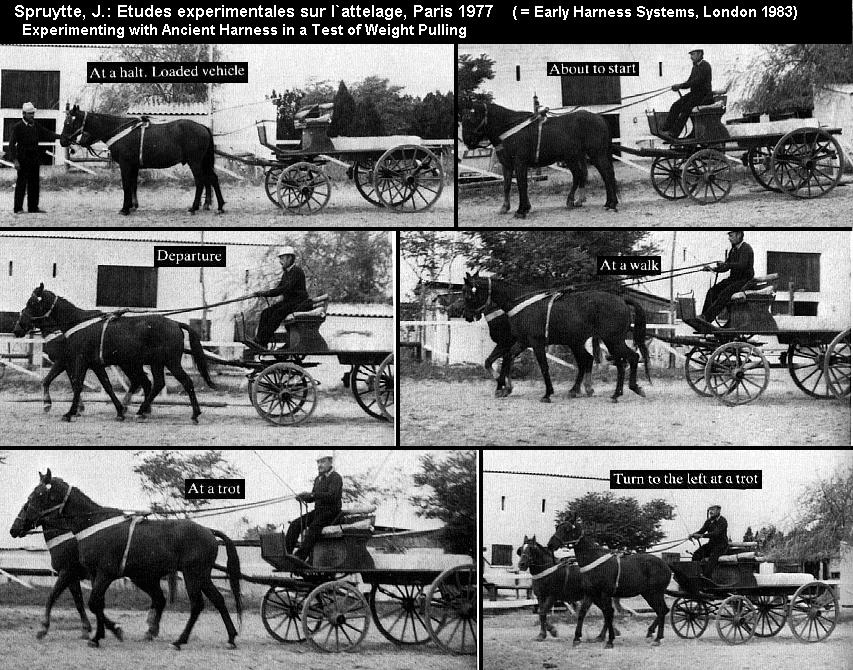
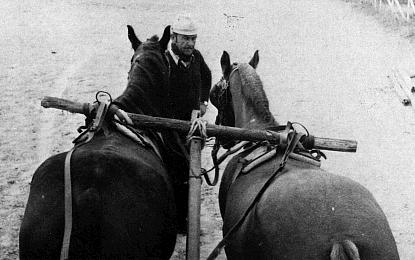
| Spruytte's experiment on Roman "Throat and Girth" harnessing. Lefebvre des Noettes claimed a maximum useful weight of 500 kg as a limit for such a harness. Spruytte achieved 1 ton of total load (car and cargo) even on sandy ground without problems. Therefore, several tons could be hauled on the hard surface of a Roman road. The undisputed fact that the Romans never used such harnessing for heavy haulage must have other reasons than any constraints to the horses. It is assumed that the possible high starting force of several tons a horse can achieve rendered that light strap harness as too fragile. |
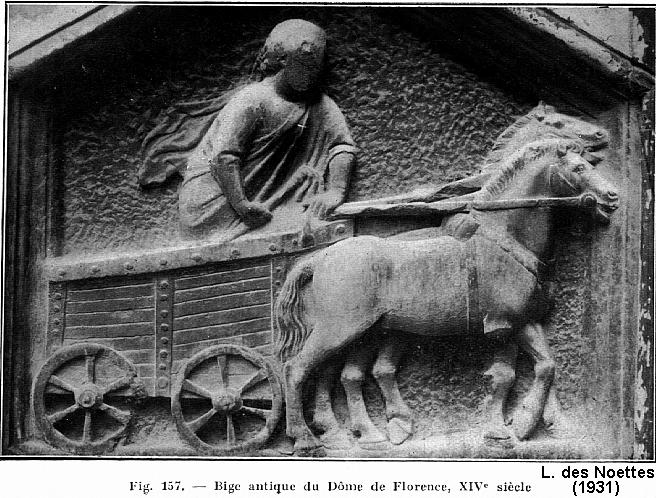 |
| Depiction of a "Throat and Girth" harness at heavy haulage. The big surprise is that this harness was not used in Roman times but in the Middle Ages. LdN thereby disproves his own theory that this type of harness strangled horses in ancient times because it was used for heavy haulage -- if the "Throat and Girth" harness really had the effects des Noettes assumes, the only known evidence for a by LdN's terms wrong usage of a "Throat and Girth" harness comes from an 14th Century artwork in the dome Florence, |
  |
|
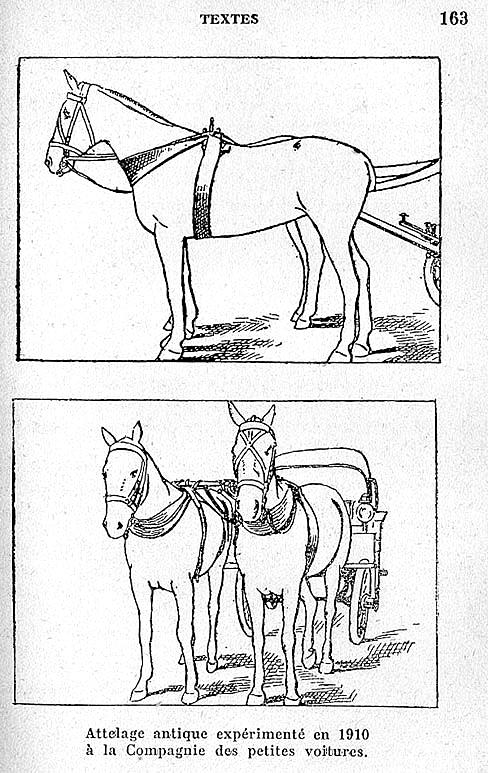
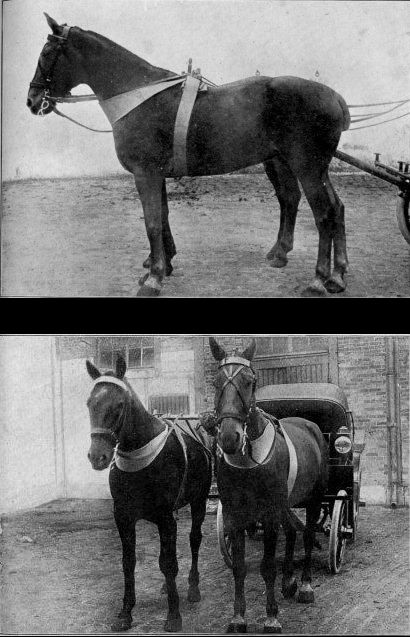
LdN's "Harness experiment sketch", page 163 of his book.
The only "proof" of his experiment in 1910. With that experiment
he claimed to have established a load limit of 500 kg. But the
car looks like a very light two-wheeler for about two persons
only. Even more important, it had modern inflated tires
and is depicted on a hard modern street like surface. Under
such circumstances, other data indicates the hores were able
to haul 5 or 10 times the load LdN claimed. To the right (or below, depending
on your screen width) you can see the original photos of LdN's experiment.
The scans of the photographs from the year 1910 were kindly provided by Gerrit Bigalski. They were published in LdN's book from 1924. |
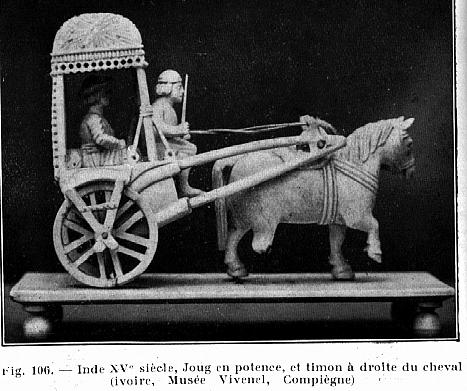 |
| A "Throat and Girth" harness on a 15th century Indian 2-wheeler. |
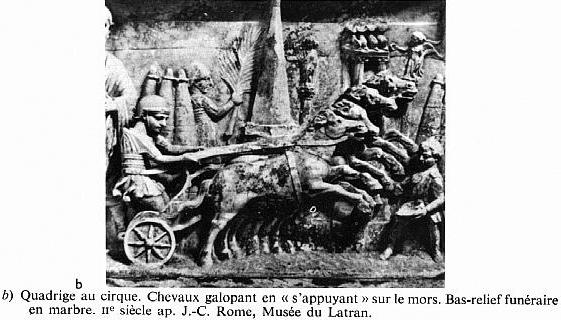 |
| A Roman "Throat and Girth" harness in a race. |
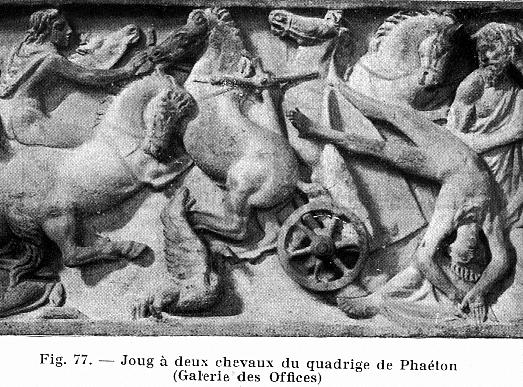 |
| LdN's Fig. 77, serious accident in a Roman chariot race showing details of a "Throat and Girth" harness. |
HTML by Erik Möller
Content by Seneca